
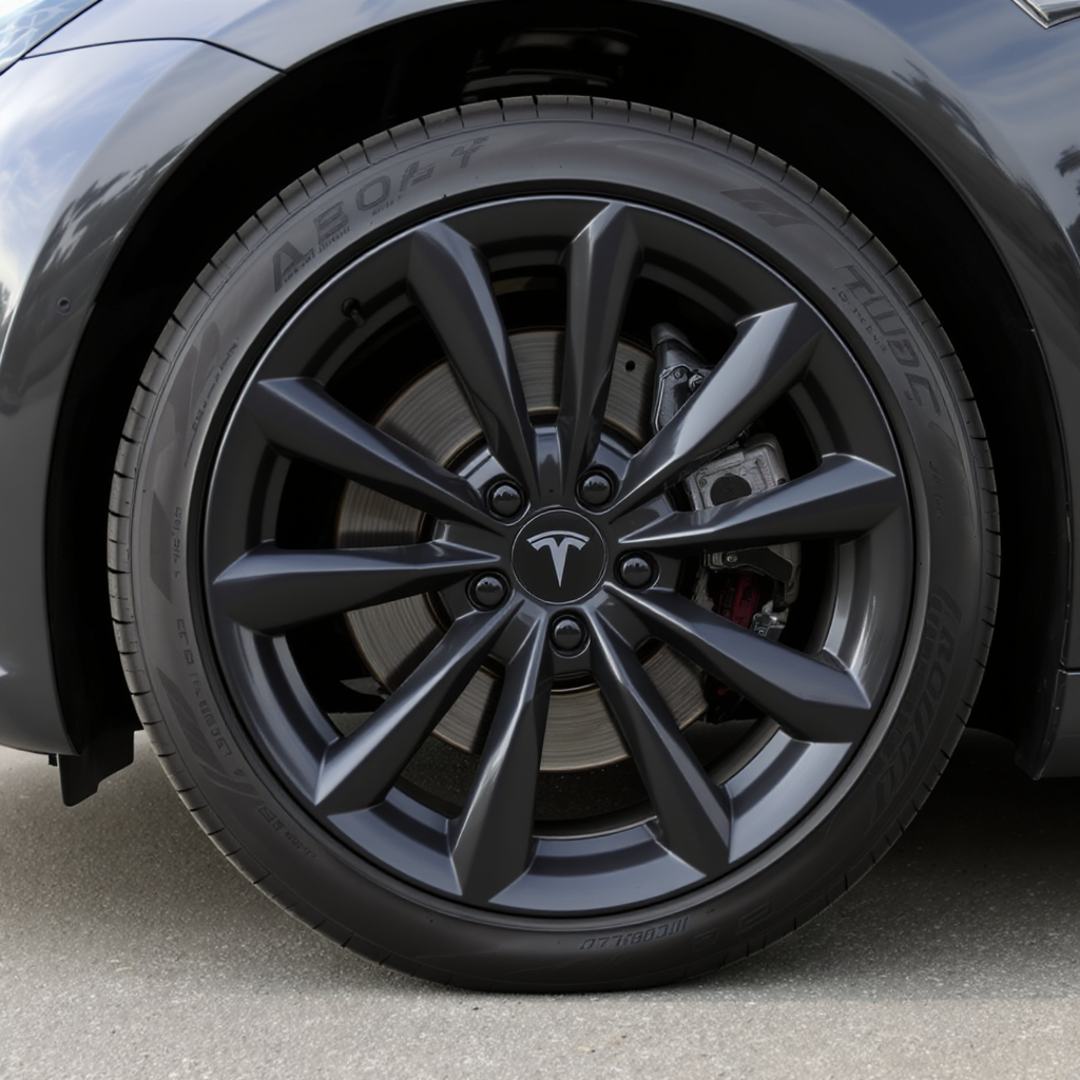
If you’ve been wondering why Tesla rear tires wear out quickly, you’re not alone. Many Tesla owners are surprised to find their rear tires wearing out much sooner than expected, often with excessive wear on the inside edge while the rest of the tread still appears in good condition. Although this can seem like a mechanical problem, it’s often the result of Tesla’s unique engineering, including the vehicle’s weight, instant electric torque, and factory suspension geometry. Understanding the reasons behind this wear pattern can help you extend tire life, improve safety, and avoid unnecessary replacement costs. Keep reading to discover what’s really causing premature rear tire wear and the practical solutions that can help protect your Tesla’s tires.
Tesla Model Y, Model S, and Model X Wear Tires Fast
Many tesla owners are surprised when their rear tires wear out faster than expected, especially on vehicles like the Tesla Model 3 (especially in the Performance trim package with AWD and offset rear wheels) and Tesla Model Y Long Range but it is especially common on the Model Y, Model S, and Model X.. While Tesla’s instant torque delivers impressive acceleration, it also places additional stress on the rear tires. Combined with the vehicle’s weight and factory suspension settings, this can lead to accelerated tire wear compared to many traditional gas-powered vehicles.
Because the wear isn’t obvious at a glance, it leads to some very common (and very reasonable) questions:
Why are my Tesla tires wearing out so fast?
Why are my Tesla tires wearing unevenly?
Why are my Tesla tires wearing on the inside edge only?
How are my Tesla tires worn out already — I just bought them!
If any of these sound familiar, you’re not alone. Uneven rear tire wear is one of the most common tire complaints Tesla owners experience, and it often happens long before most drivers expect to replace their tires.
The short answer: a Tesla is not a normal commuter vehicle, even if it looks like one.
Compared to a traditional crossover SUV like a Toyota RAV (~3,400 lbs), a Tesla Model Y weighs roughly 4,400–4,600 lbs. That extra mass is paired with instant electric torque, often 400+ lb-ft, delivered immediately through the rear wheels. Unlike a gas vehicle, there’s no gradual power ramp – every launch and acceleration event places significant load on the rear tires. Because of this combination of weight and torque, it’s common for Teslas to see 2–4x less tire life than conventional vehicles. What feels calm and efficient is, mechanically, much closer to a sports car.
Alignment further explains the wear pattern. From the factory, Tesla uses substantial negative rear camber. This is intentional. Negative camber improves high-speed stability, cornering grip, and control when entering and exiting turns. As the suspension compresses during cornering, the tire maintains a better contact patch, which improves handling and safety.
This design philosophy isn’t unique to Tesla. BMW, Mercedes-Benz, and other performance-oriented brands use similar alignment strategies. The tradeoff is straightforward: better drivability and handling at the expense of accelerated inner rear tire wear. In most cases, nothing is broken – the vehicle is behaving exactly as it was engineered to behave.
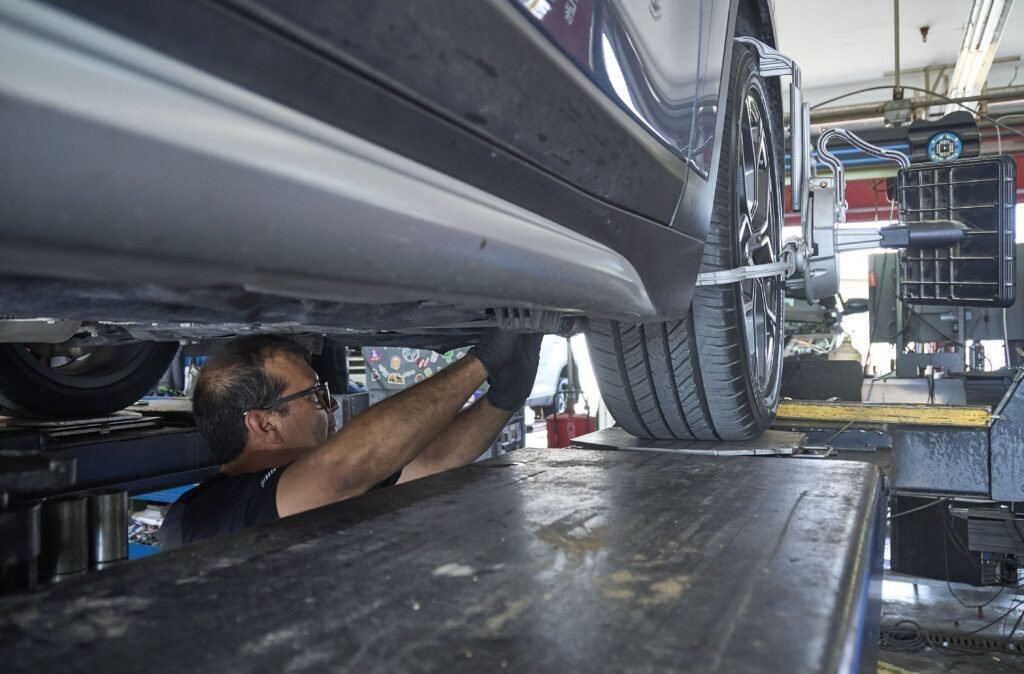
Factory Rear Camber Is Not Adjustable
Tesla uses relatively aggressive rear camber settings to improve handling, cornering stability, and overall driving performance. While these settings help vehicles such as the Tesla Model 3 and Tesla Model Y Long Range feel responsive on the road, they can also increase wear along the inner edge of the rear tires.
Negative camber causes more weight to rest on the inside portion of the tire, which may lead to uneven tread wear over time. Regular alignment checks, tire rotations, and inspections can help identify wear patterns early and extend tire life.
For drivers who regularly push the car hard with high-speed driving, aggressive cornering, or track use, this fixed camber strategy makes sense. The negative camber keeps the rear tires planted as the suspension loads in turns, improving grip and predictability.
However, most Tesla owners are not driving on the track. Daily driving is dominated by straight-line cruising, light cornering, and frequent acceleration, where that same negative camber continuously loads the inner shoulder of the tire. Over thousands of miles, the wear becomes unavoidable, regardless of how carefully the vehicle is aligned to factory specs.
In short, nothing is “wrong” with the suspension or alignment. The issue is that Tesla does not offer a factory adjustment to tailor rear camber for commuter-focused use. Without a way to reduce negative camber, owners are left replacing rear tires far more often than expected.
Adjustable Rear Camber Arms: Optimizing Your Tesla for Normal Driving
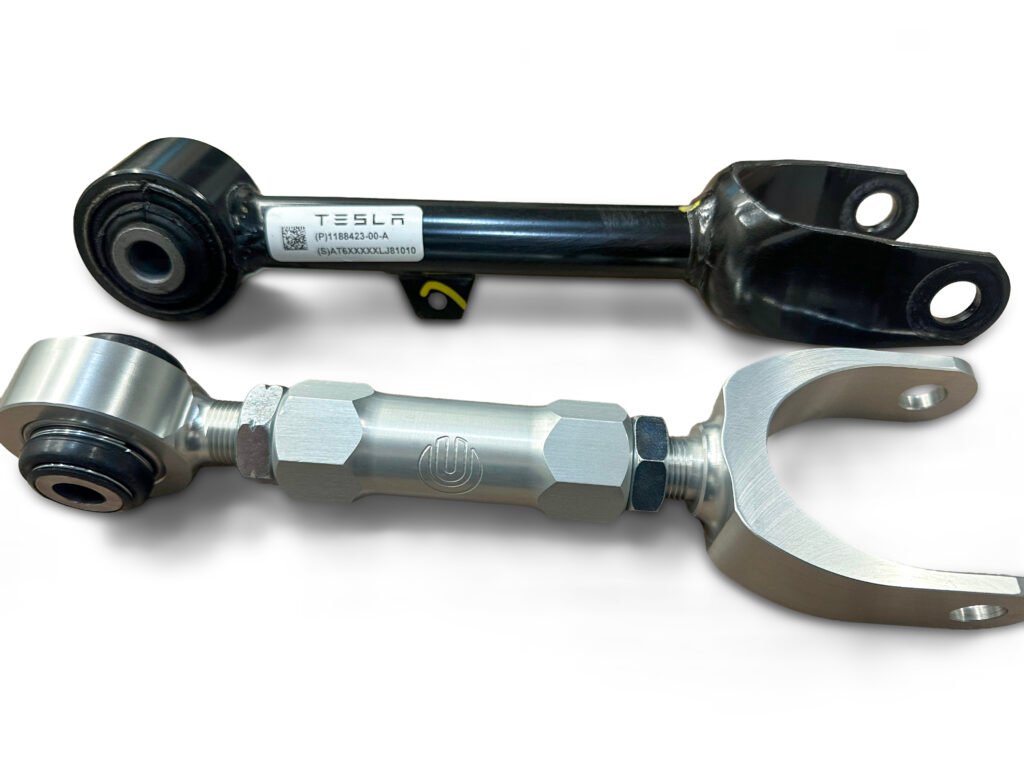
Since factory Tesla rear camber cannot be changed, the only practical way to reduce inner rear tire wear is through adjustable rear camber arms. These aftermarket components replace the stock arms and allow owners to dial in less negative camber while keeping the car’s handling predictable.
Adjustable camber arms let you:
- Reduce excessive negative camber so the tire wears more evenly
- Maintain rear stability in turns without compromising safety
- Extend tire life significantly, often doubling rear tire mileage under normal use
Installation is straightforward for a trained technician and doesn’t require major suspension modifications. Once installed, the vehicle can be aligned to an alignment setting optimized for regular driving rather than the aggressive factory angle intended for performance handling.
The benefit is clear: owners can retain the Tesla’s composure, grip, and drivability while dramatically reducing inner shoulder wear on the rear tires. For most drivers, this adjustment turns what was previously a costly and recurring maintenance issue into a manageable, long-term solution.
Can Tire Rotation or Driving Habits Fix This?
Tire rotation plays a critical role in extending tire life, especially on vehicles where rear tires wear faster than front tires. Regular rotations help distribute wear more evenly across all four tires, delaying premature replacement.
However, tire rotation alone cannot fully solve Tesla rear tire wear. While rotating tires helps balance tread wear, it does not address the underlying causes: negative camber, vehicle weight, offset rims, and instant torque.
Driving habits also matter. Smooth acceleration, avoiding hard launches, and maintaining proper tire pressure can slow wear, but these habits cannot completely overcome factory suspension geometry. For many owners, tire rotation is a helpful maintenance step, not a complete solution.
Managing Rear Tire Wear on Teslas: Key Takeaways
Inner rear tire wear on the Model Y, Model S, and Model X is not a defect – it’s a natural outcome of Tesla’s design. High vehicle weight, instant rear torque, and factory-set negative camber combine to place constant load on the inner shoulder of the rear tires. Even a perfectly “in-spec” alignment cannot prevent this.
The factory camber setup prioritizes handling, stability, and performance, which is why it cannot be adjusted at the dealership. For most drivers, the aggressive negative angle leads to accelerated wear that feels sudden but is entirely expected.
Adjustable rear camber arms provide a practical solution. By dialing in a less negative camber, owners can retain predictable handling while significantly extending rear tire life. This modification balances the original performance intent with the demands of everyday driving, turning what was a recurring maintenance concern into a manageable, long-term improvement.
For Tesla owners concerned about rear tire wear, understanding the why behind the design – and the available how for adjustment – helps set expectations and provides actionable options. With the right camber setup, Teslas can maintain both their handling characteristics and a longer-lasting set of tires.