
A car battery can fail at the worst possible moment. It powers the starter and supports your vehicle’s electrical systems, so a weak battery can quickly turn an ordinary morning into an unwanted roadside problem. Most conventional car batteries last around three to five years, although climate, driving habits, vehicle type, and maintenance can change that lifespan. If you’re wondering when to replace your car battery, don’t rely on age alone. Slow starts, dimming lights, repeated jump starts, and corrosion can reveal a battery that’s losing capacity. Timely battery testing can help determine whether you need a replacement or simply further maintenance.
How Long Does a Car Battery Usually Last?
If you’re asking how long does a car battery last, three to five years is a useful general guide for conventional automotive batteries. It’s not a fixed expiration date. Extreme temperatures, frequent short trips, long periods parked, electrical demands, and poor maintenance can all shorten battery life.
Factor | How It Can Affect Battery Life |
Battery age | Older batteries gradually lose capacity. |
Extreme heat/cold | Temperature extremes accelerate wear. |
Short trips | The battery may not fully recharge between starts. |
Long periods parked | Inactivity can gradually discharge the battery. |
Poor maintenance | Corrosion and loose connections can affect performance. |
Good car battery maintenance includes keeping terminals clean and connections secure. If your battery is approaching three years old, testing is a sensible way to check its condition rather than replacing it automatically.
Patriot Express provides car battery services to help identify battery and charging concerns before they become a starting problem.
What Are the Signs Your Car Battery Needs Replacing?
A battery often shows signs of weakness before it stops working completely. Knowing the signs you need a new battery can give you time to act before you’re left with a vehicle that won’t start.
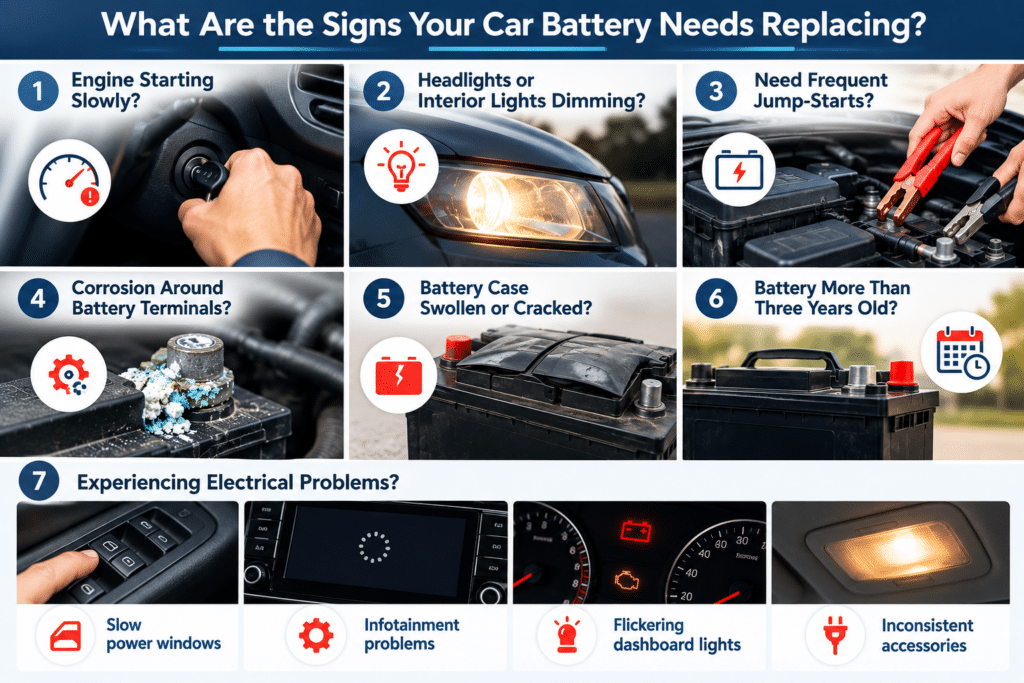
1. Is Your Engine Starting Slowly:- A sluggish crank is a common bad car battery symptom. If starting takes noticeably longer than usual, the battery may be struggling to provide enough power.
2. Are Your Headlights or Interior Lights Dimming:- Dimming or flickering lights can indicate a battery or charging-system problem. Testing helps identify the actual cause.
3. Do You Need Frequent Jump-Starts:- One jump-start may simply mean the lights were left on. Repeated jump-starts, however, can mean the battery is no longer holding its charge.
4. Is There Corrosion Around the Battery Terminals:- White, blue, or greenish buildup can interfere with the electrical connection. Significant corrosion should be professionally inspected.
5. Is the Battery Case Swollen, Cracked, or Misshapen:- Physical damage can indicate an internal battery fault. A damaged battery should be assessed promptly.
6. Is Your Battery More Than Three Years Old:- Age doesn’t automatically mean replacement. However, an older battery showing other symptoms deserves more frequent battery testing.
7. Are You Experiencing Electrical Problems:-
Watch for:
- Slow power windows: A noticeable slowdown can accompany low system voltage.
- Infotainment problems: Resets or delayed operation may indicate unstable voltage.
- Flickering dashboard lights: Changes during startup can signal an electrical concern.
- Inconsistent accessories: Several unusual electrical symptoms warrant diagnosis.
These bad car battery symptoms don’t automatically mean you need a replacement. Testing can determine whether the battery, alternator, connections, or another electrical component is causing the problem.
When Should You Replace a Car Battery Instead of Recharging It?
A dead battery doesn’t always mean it needs replacing. Leaving the lights on or the vehicle unused for too long can drain a healthy battery. The key is whether it can recover and hold a charge.
If you’re asking, when should you replace a car battery, consider these signs:
A battery may need replacement when:
- It repeatedly loses charge: It goes flat again shortly after being recharged.
- It fails battery testing: The battery cannot maintain adequate starting power.
- It is significantly aged and showing symptoms: Age combined with slow starts or electrical issues is more concerning.
- It has physical damage: Swelling, cracks, or leaks can indicate an internal fault.
- It cannot maintain starting power: Recharging provides only temporary improvement.
A battery may only need charging when:
- It was accidentally discharged: For example, the headlights were left on.
- It passes a battery health test: Testing confirms that the battery still has usable capacity.
- The charging system works correctly: The alternator can recharge the battery properly.
- There is no physical damage: A sound battery may recover after a complete charge.
This is why battery testing should come before replacement whenever possible. A faulty alternator can also leave a healthy battery repeatedly discharged.
How Can You Tell If the Battery or Alternator Is the Problem?
The battery starts the engine. The alternator then supplies electrical power while the engine runs and restores the battery’s charge.
Battery Problem | Alternator Problem |
Slow engine crank | Battery repeatedly loses charge |
Difficulty starting | Charging warning appears |
Starting-related electrical issues | Electrical problems while driving |
Battery fails testing | Abnormal charging voltage |
Because symptoms can overlap, battery testing should ideally include a check of the charging system. Replacing a battery won’t solve the problem if a failing alternator is draining it.
Patriot Express offers battery and alternator services to help identify which component actually needs attention.
What Should You Check Before Buying a New Car Battery?
A car battery replacement needs to match your vehicle, not simply fit inside it. The correct specifications help ensure reliable starting and proper electrical performance.
Before replacing your battery, check:
- Vehicle specifications: Confirm the make, model, year, and engine.
- Battery size: Make sure the replacement physically fits and has the correct terminal layout.
- Battery type: Check whether your vehicle requires a conventional, AGM, or EFB battery.
- CCA rating: Choose the required Cold Cranking Amps for dependable starting.
- Reserve capacity: Consider the manufacturer’s required reserve capacity.
- Test results: Confirm the existing battery actually needs replacement.
- Charging system: Rule out an alternator problem before installing a new battery.
- Warranty: Compare coverage as well as price.
Modern vehicles can have substantial electrical demands, so the right car battery replacement should follow the manufacturer’s specifications rather than simply the cheapest available option.
How Can You Extend the Life of Your Car Battery?
A few simple habits can help your battery remain dependable for longer. Good car battery maintenance won’t prevent normal battery aging, but it can reduce avoidable problems and help you spot trouble early.
Battery Maintenance Checklist
- Keep the terminals clean: Remove significant corrosion so the electrical connection remains reliable.
- Check the connections: Make sure battery cables are secure and aren’t visibly loose or damaged.
- Switch off electrical accessories: Turn off lights, chargers, and other accessories before leaving the vehicle.
- Drive regularly: Regular use allows the charging system to replenish the battery.
- Test an aging battery: Arrange battery testing as the battery approaches the later part of its expected lifespan.
- Address starting problems early: A slow crank shouldn’t become something you simply work around.
- Check the charging system: A battery depends on the alternator to restore its charge while driving.
These small steps can make car battery maintenance easier and more effective. If your battery is already showing signs of weakness, maintenance alone may not be enough.
When Should You Get Your Car Battery Professionally Tested?
Professional battery testing is useful because a battery can appear perfectly normal while its ability to hold a charge is declining. Testing is especially worthwhile when the battery is aging, or your vehicle begins showing unusual starting or electrical behavior.
Get your battery checked if:
- Your vehicle starts slowly: A weaker crank can indicate declining battery performance.
- Your battery is three or more years old: Age increases the value of regular testing.
- You need frequent jump-starts: Repeatedly restoring the battery’s charge may only be treating the symptom.
- Electrical systems behave strangely: Flickering lights or inconsistent accessories deserve investigation.
- You notice corrosion or physical damage: These can affect battery performance and safety.
Patriot Express offers car battery service to help identify battery and charging-system problems. A proper check can tell you whether the battery needs replacing or whether another component is responsible.
Conclusion
Most conventional car batteries last around three to five years, but age is only one part of the decision. Slow starts, dimming lights, repeated jump starts, corrosion, and other electrical issues can point to a weakening battery. Battery testing can help confirm whether replacement is necessary, while checking the alternator can rule out charging problems.
Good car battery maintenance can extend useful battery life, but it cannot stop normal aging. If your vehicle is showing bad car battery symptoms, schedule an inspection with Patriot Express Tire & Oil in Plano. Their technicians can test the battery and charging system and help determine whether you need a replacement.